
The Spinal Column: How Your Spine Works
The spinal column is a flexible stack of 33 vertebrae, separated by cushioning discs, that supports your body and protects the spinal cord. It has five regions — cervical, thoracic, lumbar, sacrum, and coccyx — and 31 pairs of spinal nerves branch out from it to the rest of the body.
- 33vertebrae in the spine
- 5spinal regions
- 23intervertebral discs
- 31pairs of spinal nerves
What Is the Spinal Column?
The spinal column, also called the vertebral column or backbone, is the chain of bones that runs from the base of the skull to the pelvis. It does three jobs: it holds your body upright, lets you bend and twist, and forms a protective bony tunnel around the spinal cord.
Your brain and spinal cord are the body's communication center. Nerve signals travel up and down the spinal cord and out through spinal nerves to every muscle, joint, and organ. The skull protects the brain with solid bone — but a solid tube would leave you unable to move. Instead, the spine uses many small, interlocking vertebrae that are strong enough to protect the cord yet flexible enough for everyday motion.
That's why chiropractors focus on the spine: when its joints, discs, and supporting muscles are injured or not moving well, the result can be pain, stiffness, and irritated nerves.
The 5 Regions of the Spine
Each region has a different shape and job — and tends to be injured in different ways.
| Region | Vertebrae | What it does | Common problems | How we help |
|---|---|---|---|---|
| Cervical spineC1–C7 · Neck | 7 | Supports and moves the head; C1 (atlas) and C2 (axis) allow nodding and rotation. | Whiplash, neck pain, headaches, pinched nerves causing arm tingling | Gentle adjustments, myofascial release, manual traction |
| Thoracic spineT1–T12 · Upper and mid back | 12 | Anchors the ribs and protects the heart and lungs; the most stable region. | Mid-back pain, muscle strain, rib joint irritation, posture-related stiffness | Diversified and drop-table adjustments, soft-tissue work |
| Lumbar spineL1–L5 · Lower back | 5 | Carries most of the upper body's weight and allows bending and lifting. | Low back pain, herniated or bulging discs, sciatica | Flexion-distraction, intersegmental traction, core rehab |
| SacrumS1–S5 · Base of the spine | 5 fused | Connects the spine to the pelvis at the sacroiliac (SI) joints. | SI joint pain, pain in the buttock or back of the thigh | Pelvic and SI joint adjustments, stabilizing exercise |
| Coccyx (tailbone)Co1–Co4 · Tailbone | 4 fused | Anchors muscles and ligaments of the pelvic floor. | Tailbone pain after a fall or prolonged sitting | Gentle mobilization, soft-tissue therapy, sitting guidance |
Discs, Nerves & Natural Curves
Intervertebral Discs
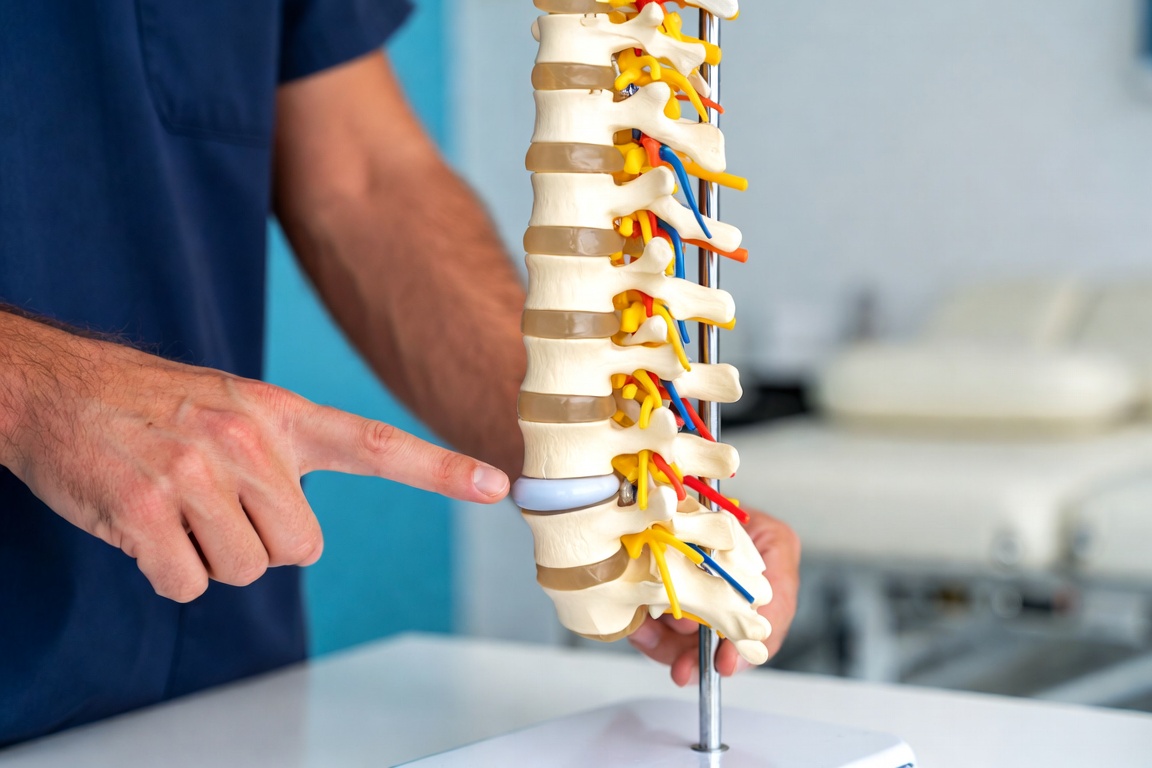
23 discs sit between the vertebrae from the neck to the lower back. Each has a tough outer ring (annulus fibrosus) around a gel-like center (nucleus pulposus). They absorb shock and allow movement. When the outer ring weakens or tears, the center can bulge or herniate and press on a nearby nerve.
Spinal Cord & Nerves
The spinal cord runs from the brain down to about the L1–L2 level in adults, then continues as a bundle of nerve roots. 31 pairs of spinal nerves exit through small openings between the vertebrae. Irritation at those openings can cause pain, tingling, or weakness in the arms or legs.
Natural Spinal Curves
Seen from the side, a healthy spine forms a gentle S-shape: inward curves in the neck and lower back (lordosis) and an outward curve in the upper back (kyphosis). These curves balance your head over your pelvis and act like a spring when you walk, run, and lift.
How Car Accidents and Injuries Affect the Spine
In a collision, your head and torso are thrown forward and back faster than your muscles can react. That sudden motion can sprain neck ligaments (whiplash), strain muscles, irritate the small facet joints between vertebrae, and injure discs in the neck or lower back. Work injuries, falls, and sports injuries load the spine in similar ways.
Spine injuries often don't hurt right away. Inflammation builds over the next day or two, which is why an early exam matters — both for your recovery and for documenting an injury claim.
Spine Symptoms That Need Emergency Care
Go to the emergency room or call 911 — don't wait for a chiropractic visit — if back or neck pain comes with any of these:
- Numbness in the groin, buttocks, or inner thighs ("saddle" numbness)
- New loss of bladder or bowel control
- Leg or arm weakness that is getting worse
- Pain after a major trauma, such as a high-speed crash or a fall from height
- Back pain with fever, unexplained weight loss, or a history of cancer
How a Chiropractor Helps Your Spine
Dr. Thanh Pham, DC starts with a full history and exam to find which joints, discs, and muscles are involved, and orders X-rays when needed. Treatment focuses on restoring normal motion, calming irritated tissue, and strengthening the muscles that support your spine.
If your exam shows something that needs a medical doctor, imaging, or a specialist, he'll tell you and refer you.
- Chiropractic adjustments — Diversified and Thompson drop-table techniques
- Flexion-distraction — gentle decompression for disc bulges and sciatica
- Traction — intersegmental table and manual traction
- Soft-tissue therapy — myofascial release and massage
- Rehab exercise — core and postural strengthening
6 Habits for a Healthier Spine
- 1
Move Often
Stand up and walk for a few minutes every 30–60 minutes of sitting.
- 2
Lift With Your Legs
Bend your knees, keep the load close, and avoid twisting while lifting.
- 3
Set Up Your Screen
Keep monitors at eye level so your neck isn't bent forward for hours.
- 4
Strengthen Your Core
Strong abdominal and back muscles share the load with your discs.
- 5
Adjust Your Headrest
Set your car headrest level with the back of your head to limit whiplash.
- 6
Don't Ignore Pain
Get new or lingering pain checked early, especially after a crash or fall.
Spinal Column FAQs
How many vertebrae are in the human spine?
The human spine has 33 vertebrae: 7 cervical, 12 thoracic, 5 lumbar, 5 fused vertebrae that form the sacrum, and 4 fused vertebrae that form the coccyx (tailbone). The 24 vertebrae above the sacrum can move independently.
What are the five regions of the spine?
The five regions of the spine are the cervical spine (neck), thoracic spine (upper and mid back), lumbar spine (lower back), sacrum, and coccyx (tailbone).
What is the difference between the spinal column and the spinal cord?
The spinal column is the stack of bones (vertebrae) and discs that forms your backbone. The spinal cord is the bundle of nerves that runs through a canal inside the spinal column, carrying messages between the brain and the body.
How many spinal nerves are there?
There are 31 pairs of spinal nerves: 8 cervical, 12 thoracic, 5 lumbar, 5 sacral, and 1 coccygeal. They exit the spine through small openings between the vertebrae called intervertebral foramina.
What do intervertebral discs do?
Intervertebral discs are cushions between the vertebrae. Each has a tough outer ring (annulus fibrosus) and a gel-like center (nucleus pulposus). They absorb shock and let the spine bend and twist.
Why does the spine have curves?
A healthy spine has an S-shaped profile when viewed from the side: an inward curve in the neck and lower back (lordosis) and an outward curve in the upper back (kyphosis). These curves balance the head over the pelvis and absorb shock when you walk and run.
Where do herniated discs happen most often?
Herniated discs happen most often in the lower back, especially between L4 and L5 and between L5 and S1. These levels carry the most load, and a herniation there can irritate the nerve roots that form the sciatic nerve.
How can a car accident injure the spine?
In a collision, the head and torso are thrown forward and back faster than the muscles can react. This can sprain neck ligaments (whiplash), strain muscles, irritate facet joints, and injure discs in the neck or lower back, sometimes with symptoms that appear a day or more later.
How does a chiropractor help the spine?
A chiropractor examines how your spinal joints move and uses adjustments, flexion-distraction, traction, soft-tissue therapy, and exercise to restore motion and reduce pain. At Smiley Chiropractic in Garland, TX, Dr. Thanh Pham, DC builds each plan after a one-on-one exam. Call (972) 494-5155.
Sources
- Anatomy, Back, Vertebral Column — StatPearls, National Library of Medicine (NCBI Bookshelf)
- Spine: Anatomy, Function, Parts, Segments & Disorders — Cleveland Clinic
Medically reviewed by Dr. Thanh Pham, DC, Texas-licensed chiropractor · Last updated . This page is educational and does not replace an in-person exam. Every injury is unique, and Dr. Pham must examine you before making recommendations.
Request a Free Consultation
Hurt in an accident or dealing with neck or back pain? Tell us what happened and our Garland team will call you to schedule — often the same day. Prefer to talk now? Call (972) 494-5155.
What your free consultation includes
A one-on-one conversation with Dr. Pham about your symptoms, injury, or accident, and his recommendation on whether chiropractic care is right for you. Examinations, X-rays, and treatment are not part of the free consultation; we'll explain any costs before additional services are performed.